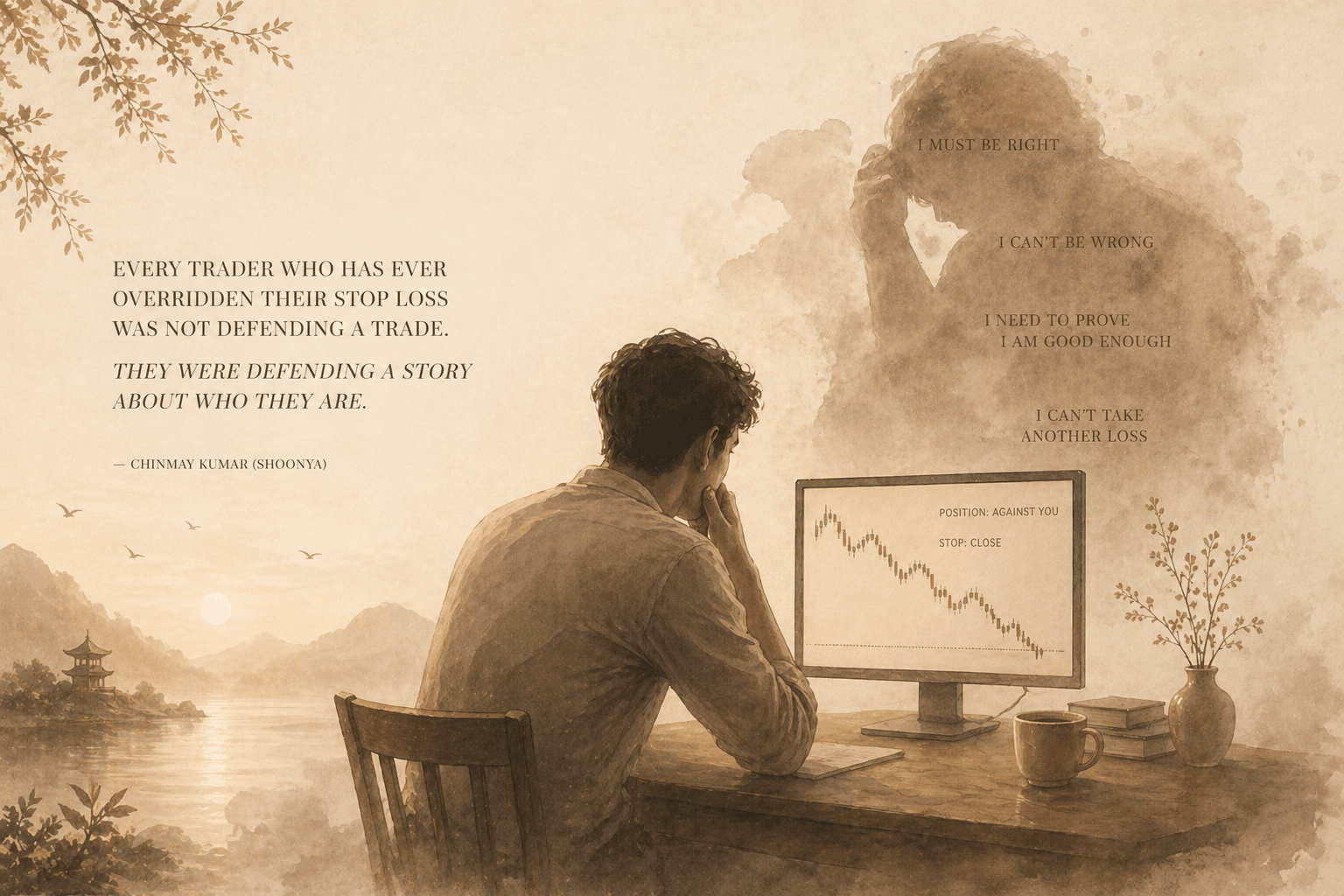
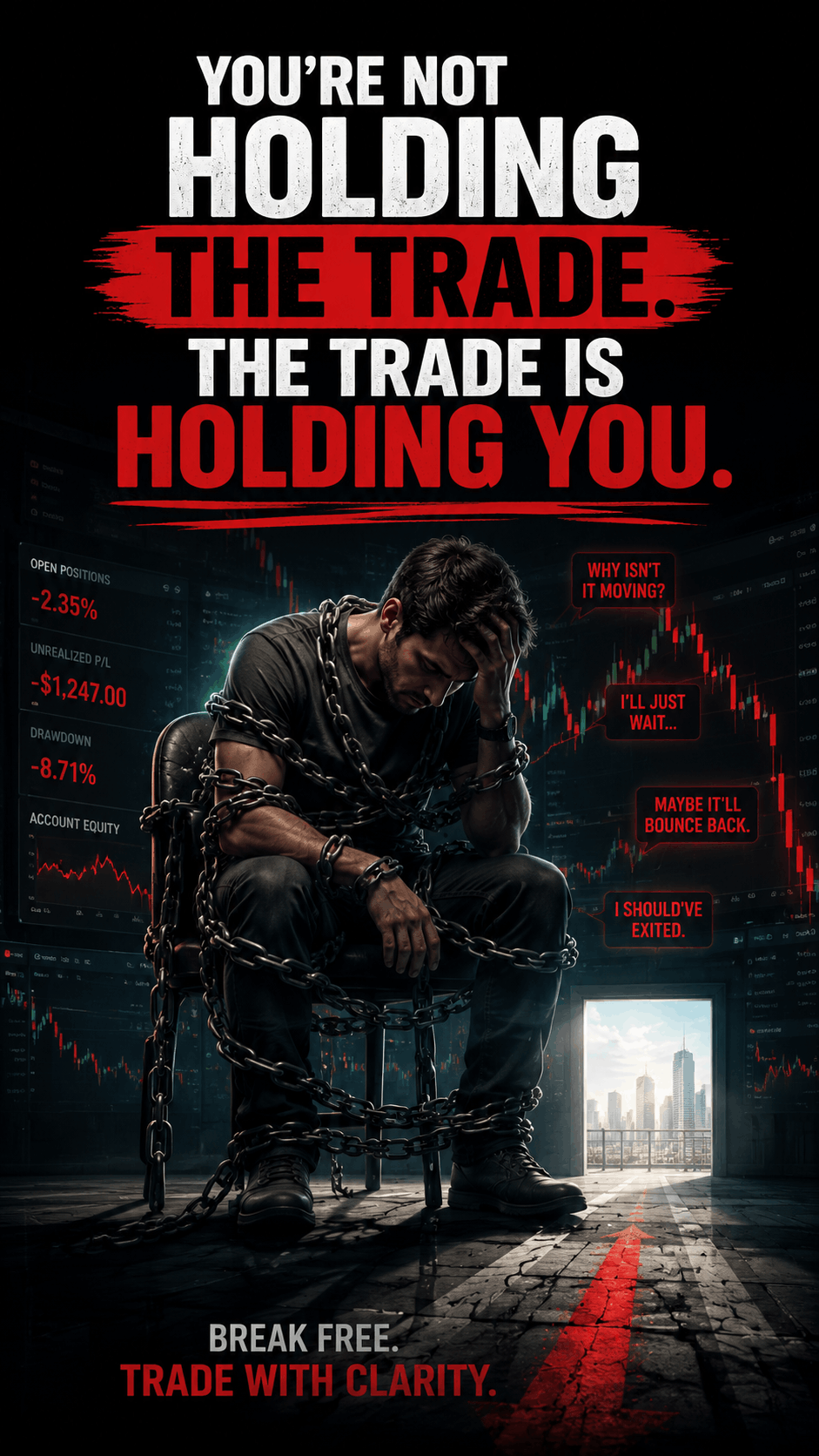
The position is going against you. The stop is close. And somewhere inside, before the loss even hits, something else is already happening — something faster, quieter, and far more painful than the trade itself.
You are waiting to be confirmed.
"Every trader who has ever overridden their stop loss was not defending a trade. They were defending a story about who they are."
Part one
The real position you are holding
Most people who come to the market think they are here to make money. They are not. They are here to prove something. That they are intelligent. That they can figure it out. That they — unlike everyone else — have what it takes.
The money is not the point. The money is the scoreboard. And the scoreboard is how they measure whether the story they believe about themselves is true or not.
This is why a losing trade does not just cost capital. It costs certainty. And for most people, certainty about who they are is more expensive than any position size they will ever hold.
Part two
Shame in disguise
Watch what happens in the body the moment a trade starts failing. The jaw tightens. The screen gets checked more frequently. The analysis that was crystal-clear at entry suddenly grows complicated, uncertain, negotiable.
That is not risk management. That is shame looking for an exit.
The mind will do extraordinary things to avoid a loss — not because the money matters that much, but because somewhere underneath the chart, there is a belief quietly waiting to be confirmed: I knew I wasn't good enough for this.
"The market does not care about your story. It moves. You are the one who made the loss mean something about your worth."
Part three
What is actually being protected
Think about the last time you held a losing trade too long. Was it really because the analysis said to hold? Or was it because cutting the loss felt like admitting something you were not ready to admit?
There is a belief most traders carry without ever examining it: if I lose, I am a loser. Not just in the market — in the deepest, oldest sense of the word.
This belief was not born at a trading desk. It was built long before charts existed — in classrooms, in families, in every moment a child was told that their value depended on their results. The market simply activates it. The price action becomes a verdict, not data.
Part four
The only trade worth taking seriously
Real discipline in trading is not about following rules. Anyone can follow rules in a simulator. Real discipline is the ability to take a loss and feel nothing beyond what the loss actually is — a data point, a tuition fee, a piece of honest feedback from reality.
That kind of discipline is not built by reading more books on technical analysis. It is built by sitting down with the belief that drives the fear and asking it a direct question: what exactly are you afraid of being proven?
Most traders never ask. They tighten their stop rules instead. They build better systems. They optimize entries. And they keep bleeding — not because the strategy is wrong, but because the person running it is trying to trade their way out of a psychological wound that predates every candle on the chart.
"The loss you are avoiding is never the loss on the screen. It is the conclusion you are terrified to reach about yourself."
A bad trade does not make you a bad trader. It makes you someone who took a bad trade. The market has always known the difference. The question is whether you are ready to know it too.
— Chinmay Kumar (Shoonya)
You Don't Fear Losing Money. You Fear Being Proven Right About Yourself.