The Boredom Is the Edge
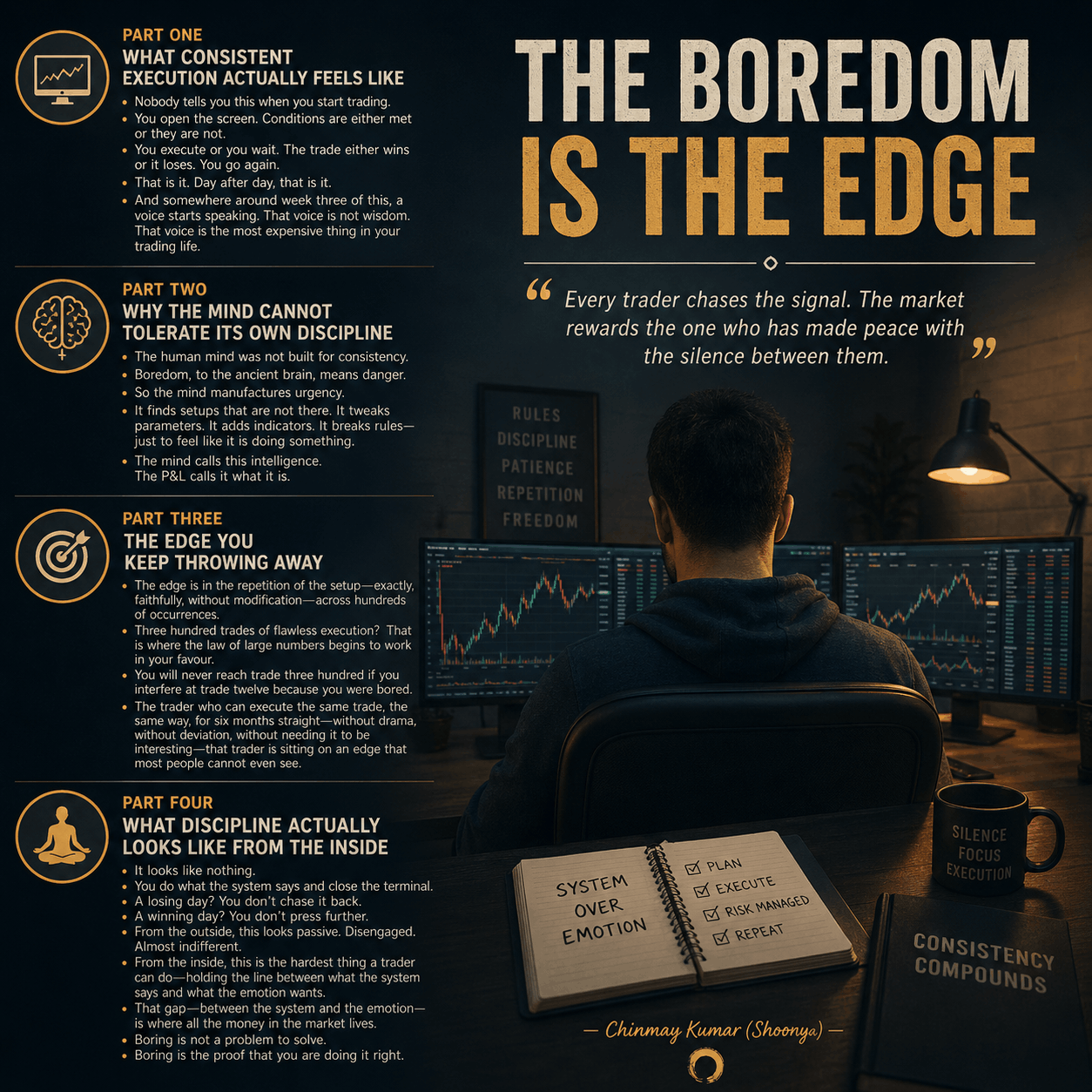
"Every trader chases the signal. The market rewards the one who has made peace with the silence between them."
What consistent execution actually feels like
Nobody tells you this when you start trading.
They tell you about setups. About entries and exits. About managing your risk. What they do not tell you is that once you have built a real system — one that actually works — the experience of running it is almost completely unremarkable.
The screen opens. The conditions are either met or they are not. You execute or you wait. The trade either wins or it loses. You go again.
That is it. Day after day, that is it.
And somewhere around week three of this, a voice starts speaking. Softly at first, then louder. Something is wrong. This cannot be right. Where is the excitement? Where is the edge?
That voice is not wisdom. That voice is the most expensive thing in your trading life.
Why the mind cannot tolerate its own discipline
The human mind was not built for consistency. It was built for survival — which required novelty, reaction, constant scanning for threat and opportunity.
Boredom, to the ancient brain, means danger. It means nothing is happening. And if nothing is happening, you might be missing something.
So the mind manufactures urgency. It finds setups that are not there. It tweaks parameters that do not need tweaking. It adds one more indicator, tries one more timeframe, takes one more trade outside the rules — just to feel like it is doing something.
The mind calls this intelligence. The P&L calls it what it is.
Consistent execution feels boring because your nervous system is calibrated for drama and your system is calibrated for probability. These two things are incompatible. One of them has to win.
The edge you keep throwing away
Here is what the top 1% of traders understand that almost no one else does:
The edge is not in the setup. The edge is in the repetition of the setup — exactly, faithfully, without modification — across hundreds of occurrences.
A single trade proves nothing. Fifty trades prove very little. Three hundred trades of flawless execution? That is where the law of large numbers begins to work in your favour. That is where the statistical advantage built into your system starts to compound into something real.
But you will never reach trade three hundred if you interfere at trade twelve because you were bored.
The trader who can execute the same trade, the same way, for six months straight — without drama, without deviation, without needing it to be interesting — that trader is sitting on an edge that most people cannot even see, because they discarded it the moment it stopped feeling exciting.
What discipline actually looks like from the inside
It looks like nothing.
It looks like a man who opens his terminal, checks his conditions, does what the system says, and closes the terminal.
It looks like someone who had a losing day and does not feel the need to make it back before the session ends.
It looks like someone who had a winning day and does not feel the need to press further because confidence is suddenly high.
From the outside, this person looks passive. Disengaged. Almost indifferent.
From the inside, this person is doing the hardest thing a trader can do — they are holding the line between what the system says and what the emotion wants.
That gap — between the system and the emotion — is where all the money in the market lives. On one side of that gap is the trader who lasts. On the other side is everyone else.
Boring is not a problem to solve. Boring is the proof that you are doing it right.
— Chinmay Kumar (Shoonya)
Consistent execution feels boring. That feeling is the edge you keep discarding.