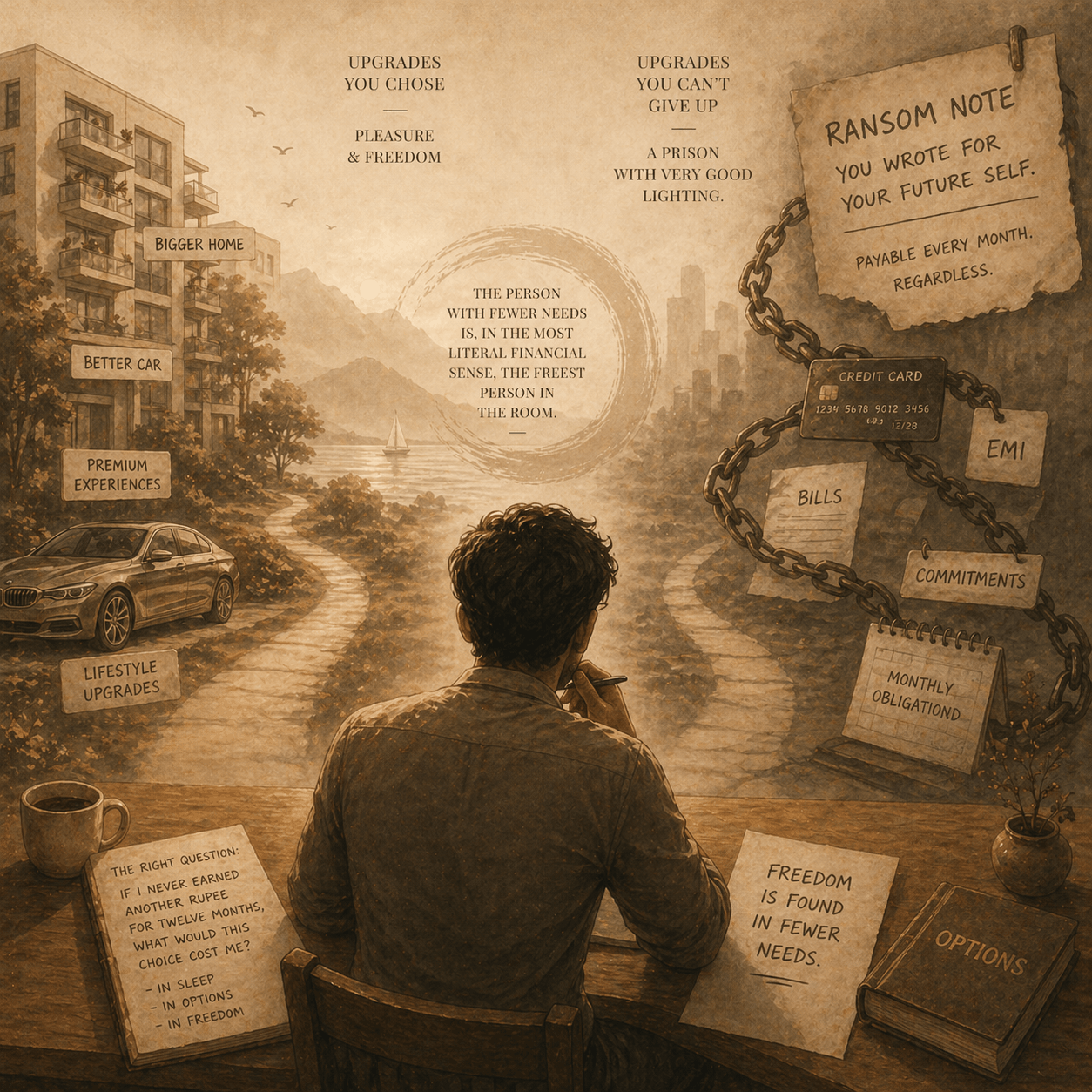
The Ransom Note You Wrote Your Future Self
"Most people think they are upgrading their life. They are actually upgrading the price of their freedom."
There is a peculiar trap that modern prosperity has built — and most of us walked into it smiling. We called it comfort. We called it progress. We called it deserving better.
It is none of those things. It is a ransom note.
How the trap works
The first apartment felt like enough. Then it didn't. The car that got you from A to B became the car that embarrassed you in a certain parking lot. The restaurant tier shifted. The holiday budget adjusted. The weekend plans evolved. Each time, the mind produced the same sentence — I've worked hard for this. I deserve it.
And perhaps you did. That is not the question. The question is simpler and more uncomfortable: what happens to you if it stops?
Because here is what you actually did. You signed a contract — not with a bank, not with a landlord — with your own future risk-tolerance. Every upgrade you normalised became a minimum. And every minimum became a monthly payment that your future self must now afford, regardless of what life decides to do.
The mathematics of normalisation
A person who needs ₹40,000 a month to feel stable has a completely different inner life than a person who needs ₹1,40,000 to feel stable. Not a better life — a different life. The second person is not richer. They are more expensive. And a more expensive life is, by definition, a more fragile one.
When income is consistent, this is invisible. When income is interrupted — through a market downturn, a health event, a business that doesn't work, a season that simply does not cooperate — the trap becomes visible in a way that cannot be unseen.
"The person with fewer needs is not poor. They are, in the most literal financial sense, the freest person in the room."
What no one tells you about lifestyle
Lifestyle inflation is not a spending problem. It is an identity problem. At some point, the apartment you live in stopped being a place to sleep and became proof of something — proof to you, to someone you once knew, to an idea you carry of what success looks like.
Once a lifestyle becomes identity, it can no longer be negotiated with. You cannot cut what you believe you are.
This is why financial advice that begins with the spreadsheet always fails. The numbers are not the disease. The unexamined story is the disease.
The only question worth asking
Not: Can I afford this?
That question is a trap. Of course you can afford it — today. Today is not the variable that matters.
The right question is: If I never earned another rupee for twelve months, what would this choice cost me?
Not in money. In sleep. In options. In the particular quality of freedom that comes from not being cornered by your own standard of living.
Ask that question before every upgrade. You do not have to choose austerity. You only have to choose consciously.
Because an upgrade you chose is a pleasure. An upgrade you can no longer give up is a prison with very good lighting.
"Financial freedom is not about how much you earn. It is about how little you need to feel whole."
— Chinmay Kumar (Shoonya)
The Ransom Note You Wrote Your Future Self