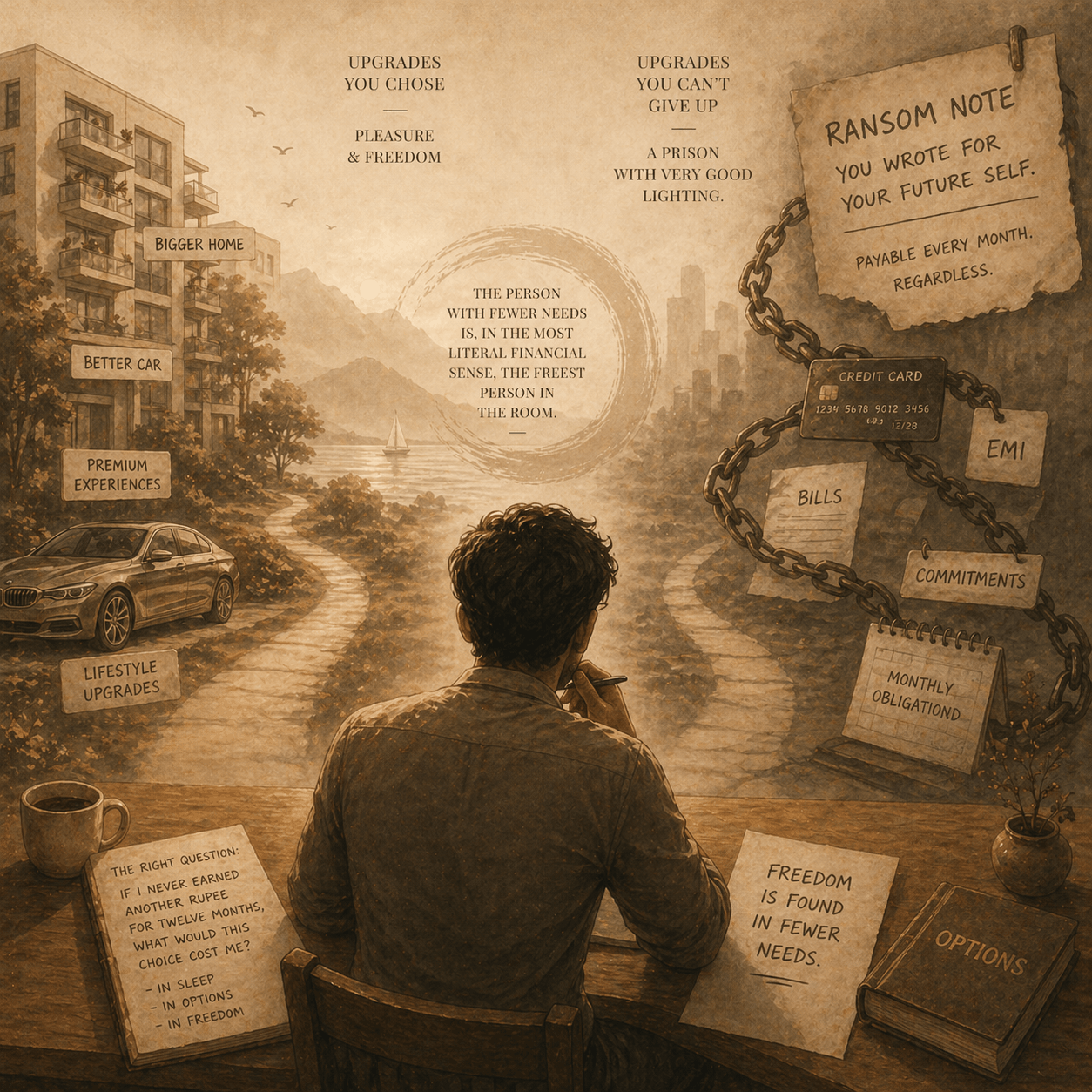
You Don't Want to Be Rich. You Want to Stop Feeling Behind.
"Most financial anxiety is not about money. It is about comparison. And comparison is a game with no finish line — because someone else drew the board."
Think about the last time you felt genuinely anxious about money. Now ask yourself honestly — was it because you couldn't pay your rent? Or was it because someone your age just bought a car, took a vacation, or posted a number that made yours feel small?
Most people cannot answer this question without some discomfort. That discomfort is the beginning of real financial clarity.
The Comparison Economy
We live inside an economy that has never been more visible. Every lifestyle, every net worth milestone, every investment win — announced, displayed, performed. Your feed is a financial highlight reel of people you went to school with, people you barely know, people who may themselves be performing a prosperity they don't fully own.
And every time you scroll through it, your brain does something very specific: it recalibrates your baseline. What felt like enough yesterday no longer feels like enough today. Not because your actual circumstances changed — but because the comparison point shifted.
This is not a character flaw. This is engineering. The modern economy profits enormously from your dissatisfaction. A person at peace with what they have is not a very good consumer.
The Difference Between a Goal and an Exit
There is a fundamental difference between building wealth and escaping a feeling. One is a direction. The other is a reaction.
When you build toward something real — a paid-off home, a year of freedom, the ability to say no to work that diminishes you — money becomes a tool. You use it with intention. You save with purpose. You spend with clarity.
"When money is a tool, you decide when to pick it up. When money is a painkiller, it decides for you."
But when you are chasing wealth to escape the feeling of being behind, the chase never ends. Because the feeling is not caused by the number — it is caused by the comparison. And no number you reach will ever exist in isolation. There will always be a larger number to your left, and the algorithm will always make sure you see it.
What Enough Actually Looks Like
Enough is not a number. Enough is a relationship between your life and your values. It requires you to sit down, outside of any social input, and answer three questions:
What kind of life do I actually want to live — not perform, not display — live?
What does that life cost, honestly, without inflation from comparison?
Am I moving toward that number — or away from a feeling?
These are not comfortable questions. They are, however, the only financial questions that matter. Every spreadsheet, every investment calculator, every savings rate article becomes useful only after you have answered them. Before that, they are just fuel for more anxiety.
The Honest Move
The honest move is not to stop caring about money. Money is real. Security is real. Options are real — and money buys options. None of that is illusion.
The honest move is to stop outsourcing your financial goals to someone else's timeline. Stop measuring your Chapter 4 against someone else's Chapter 12. Stop optimizing for a feeling of arrival that keeps moving the moment you get close.
"The most expensive thing most people own is not a house or a car. It is the version of themselves they are trying to keep up with."
Figure out what your life actually costs. Build toward that. Stop running from a feeling that no bank balance has ever been able to cure.
That is not pessimism. That is the beginning of real wealth.
— Chinmay Kumar (Shoonya)
You Don't Want to Be Rich. You Want to Stop Feeling Behind.