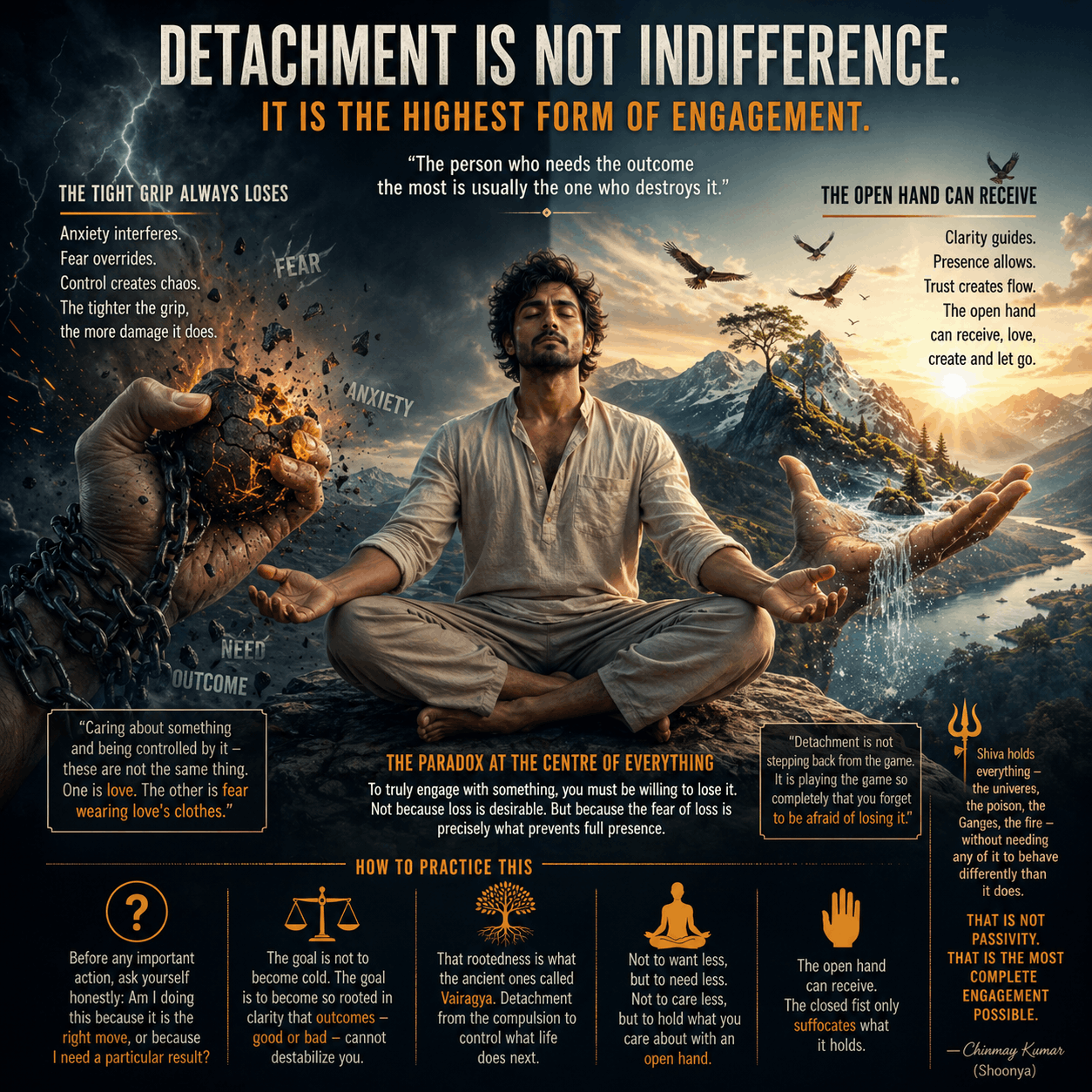
Detachment Is Not Indifference. It Is the Highest Form of Engagement.
"The person who needs the outcome the most is usually the one who destroys it."
What you were taught about detachment is wrong
At some point, someone told you that detachment means not caring. That to be free, you must feel nothing. That the seeker who sits in silence has simply switched off the part of themselves that loves, wants, and bleeds.
This is perhaps the most damaging misunderstanding in the entire vocabulary of the inner life.
Detachment is not the absence of feeling. It is the refusal to collapse into feeling. There is an enormous difference between a man who loves deeply and a man who drowns in love. Between someone who wants success and someone who cannot function without it. The first one is alive. The second one is a hostage.
"Caring about something and being controlled by it — these are not the same thing. One is love. The other is fear wearing love's clothes."
Why the tight grip always loses
Watch what happens when a person needs a specific outcome too desperately. They override the plan. They second-guess the strategy. They cannot tolerate the natural rhythm of how things unfold. In their attempt to control every variable, they introduce the biggest variable of all — their own anxiety.
The market teaches this brutally. Every trader who has ever blown an account did not do so because their strategy was wrong. They did so because they couldn't bear to watch. So they interfered. So they overrode. So they made the decision that their fear demanded, not the one that reality required.
This is not a trading problem. This is a human problem. It appears in relationships, in creative work, in every domain where the stakes are real. The tighter the grip, the more damage the grip does.
The paradox at the Centre of everything
Here is what almost no one understands: to truly engage with something, you must be willing to lose it. Not because loss is desirable. But because the fear of loss is precisely what prevents full presence.
A person who is terrified of losing a relationship cannot be fully inside the relationship. Half of them is always managing the exit, monitoring the risk, guarding against the outcome they dread. They are never fully there. And the person across from them can feel it — that subtle, constant withholding.
Detachment does not pull you out of life. It pulls you fully into it. Because when you are no longer managing the outcome, you can finally be here. Completely. Without reservation.
"Detachment is not stepping back from the game. It is playing the game so completely that you forget to be afraid of losing it."
How to practice this — practically
This is not an abstract virtue. It is a daily discipline. Before any important action — a conversation, a trade, a decision — ask yourself honestly: am I doing this because it is the right move, or because I need a particular result?
The answer to that question will tell you more about your actual state of mind than any introspection session ever will.
The goal is not to become cold. The goal is to become so rooted in clarity that outcomes — good or bad — cannot destabilize the ground you stand on. That rootedness is what the ancient ones called Vairagya. Not detachment from life. Detachment from the compulsion to control what life does next.
Shiva holds everything — the universe, the poison, the Ganges, the fire — without needing any of it to behave differently than it does. That is not passivity. That is the most complete engagement possible.
Perhaps that is the practice: not to want less, but to need less. Not to care less, but to hold what you care about with an open hand instead of a closed fist.
The open hand can receive. The closed fist only suffocates what it holds.
— Chinmay Kumar (Shoonya)
Detachment Is Not Indifference. It Is the Highest Form of Engagement.